


Carnot Core — From CAD to a Thermal-Management Prototype
My name is Alejandro Quintas, and I am an Energy Engineering student based in Seville, Spain. Carnot Core is an independent student project focused on developing and experimentally evaluating a compact thermal-management prototype for high-power electronics.
I started this project to take an engineering idea beyond simulation and turn it into something that can be manufactured and tested. It is an opportunity to connect thermal engineering, mechanical design and experimental work while gaining practical experience with the challenges of building a first physical prototype.
The long-term goal is to explore whether Carnot Core could become a practical thermal-management option for high-power electronic systems, where managing heat is an important part of reliable operation. Potential application areas include power converters, motor drives and other power-electronics industrial equipment. These are future directions to investigate, rather than applications already validated. For the first prototype, my objectives are to obtain repeatable temperature measurements under controlled conditions, compare the results with a reference configuration, and assess how closely the manufactured prototype follows the behaviour anticipated during development. This would provide a clearer basis for deciding whether further development is justified and which engineering improvements should come next.
Carnot Core is currently moving from simulation and CAD development to CNC fabrication and experimental validation. The mechanical CAD models and STEP files for the first prototype have been prepared, the geometry has been checked, and supporting manufacturing documentation has been developed.
The next step is to manufacture the prototype and evaluate its thermal behaviour in a controlled laboratory setup. The purpose of this first build is to assess feasibility, collect experimental evidence and identify improvements for future iterations. Performance has not yet been experimentally validated.
For this first build, I am seeking CNC machining support for a small set of compact aluminium prototype parts. My preferred material is EN AW-6082-T6; if this grade is unavailable, 6061-T6 would be an acceptable alternative for the initial proof-of-concept prototype. A standard machined finish is sufficient, with no anodising or decorative treatments required. Detailed geometry and manufacturing specifications are intentionally omitted from this public article because the design is confidential.
PCBWay’s CNC machining support would enable a concrete next milestone: manufacturing the first prototype and moving it into controlled experimental testing. For an independently funded student project, this support would make professional fabrication more accessible and allow more of the available resources to be directed towards measurement and evaluation. In return, I would aim to share a public development update acknowledging PCBWay’s contribution, describing the manufacturing experience and presenting non-confidential observations and lessons learned. This would offer the community a practical example of the journey from student CAD work to a manufactured and tested engineering prototype, while keeping the proprietary design confidential.
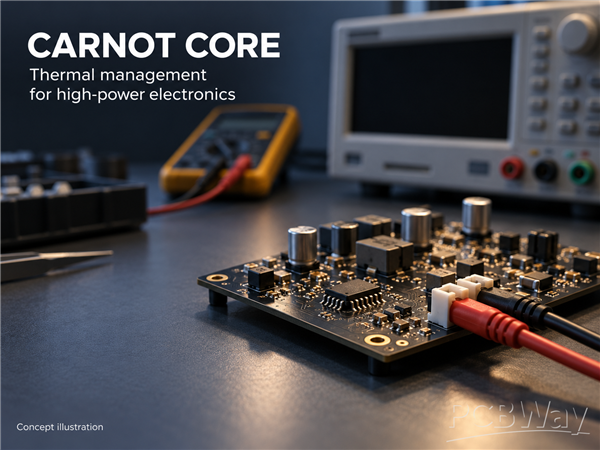
As the project progresses, I plan to share non-confidential development updates and lessons learned from fabrication and testing. The cover image is a conceptual illustration of the project’s engineering context, rather than a photograph of the actual prototype.
Thank you to the PCBWay team for considering Carnot Core and supporting independent student engineering projects!
Apply for sponsorship >>- Comments(0)
- Likes(1)