

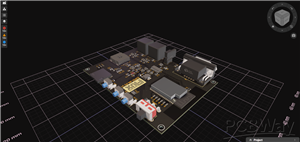
|
|
Flux PCB Editor |
ESP32 x86 PC: A Complete IBM PC/XT-Compatible Computer on a Single Board
Designed by vasy_skral | Hardware shared under CC BY 4.0 | Emulation engine by FabGL (Fabrizio Di Vittorio)
Demo video:
Original project on Flux: https://www.flux.ai/vasy_skral/esp32-x86-pc~rzy
WHAT IS THIS PROJECT ABOUT?
The ESP32 x86 PC is a self-contained retro computer designed by vasy_skral. It reproduces an IBM PC from 1985 on a custom board roughly the size of a postcard. It boots DOS and runs period software with no host computer and no emulator window. You plug in a VGA monitor, a PS/2 keyboard and a power cable, press the switch, and a DOS prompt appears.
What makes the project remarkable is how little hardware does the job. A single ESP32, a chip more commonly used for reading sensors or blinking LEDs, handles everything. The work is divided so that one half generates the VGA signal scanline by scanline, since there is no graphics card to do it, while the other half emulates an Intel 8086 processor, executing the original machine code cycle by cycle. Around that core, the firmware recreates the rest of an original PC in software: an interrupt controller, a timer chip, a keyboard controller, a real-time clock and two serial ports.
WHY BUILD THE HARD VERSION?
A modern phone can emulate hundreds of these machines without effort, so the point is not speed or convenience. A software emulator sits on top of a powerful host that does the heavy lifting. This board has no such cushion. Every cycle is counted, internal memory is tightly budgeted, and the video signal must be exact or the monitor shows static.
Combining VGA generation, CPU emulation, storage and networking on one small chip is a demanding engineering problem, and the creator describes learning more from getting it stable than from any earlier project. That struggle is documented openly in a public build log, which covers the reboot loops, the intermittent crashes and a strapping pin that quietly undermined the early prototypes.
HOW DOES IT WORK?
The ESP32 runs the whole system. One half of its workload generates the video signal for the VGA monitor. The other half runs the 8086 emulation and the emulated PC devices. Disk images are stored on a microSD card and appear to the system as drives A: through D:, covering both floppy and hard disk images.
Keyboard and mouse input pass through an emulated 8042 controller, so DOS cannot tell the difference from real hardware. The board can also use WiFi to download its own operating system images, then switch WiFi off so the emulator keeps every available cycle. Sound comes from the emulated PC timer, through the ESP32's DAC and an onboard amplifier to the speaker.
HARDWARE DESIGN
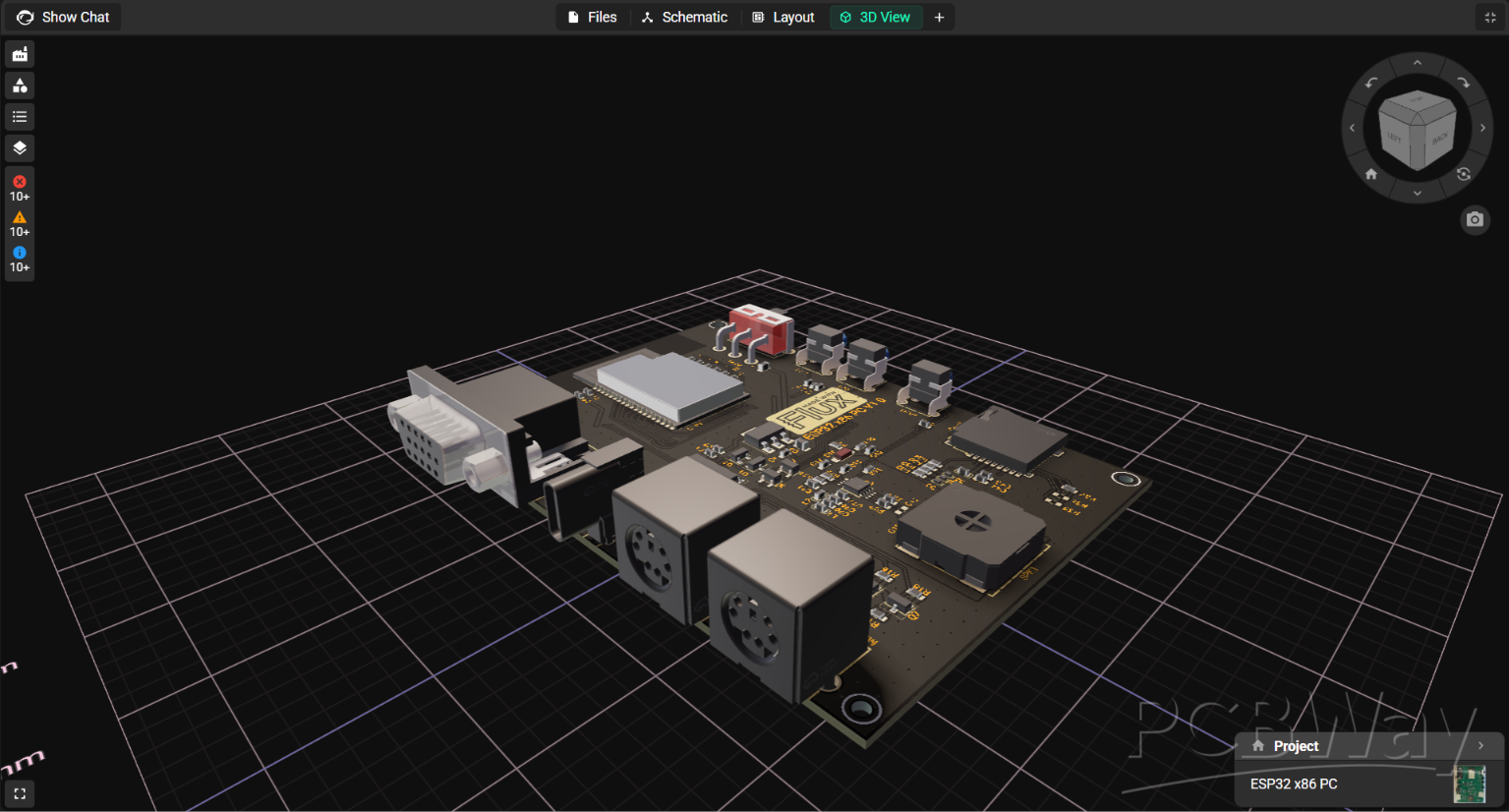
The board is designed in Flux around the ESP32-WROVER-E.
- Core module: ESP32-WROVER-E
- Emulated system: IBM PC/XT-compatible (8086), with 1 MB of RAM
- Video: VGA output (CGA and Hercules graphics) through a resistor DAC
- Input: two PS/2 ports for keyboard and mouse, with BSS138 level shifting for the 5 V lines
- Storage: microSD with card detect, a separate SDIO 3.3 V rail, and ferrite and ESD protection
- Audio: ESP32 DAC to an NS4150B Class-D amplifier and onboard speaker, with mute
- Power and programming: USB-C with CC resistors, and a CH340C USB-UART bridge
- Programming: auto-program circuit on EN and GPIO0, so flashing needs no button sequence
- Regulation: AMS1117-3.3, with split 5 V, 3.3 V, SDIO and audio-ground rails
- Board construction: four-layer (top, two inner layers, bottom)
The details around the edges are what make this design dependable: level shifting on the PS/2 lines, an isolated supply for the SD card, ESD protection and a clean auto-programming circuit.
SOFTWARE AND COMPATIBILITY
The board runs unmodified software from the original XT era. Supported operating systems include FreeDOS, MS-DOS 3.31 to 6.22, SvarDOS, Windows 2.0 and 3.0, GEM, GEOS, Linux ELKS and CP/M-86. Applications range from Turbo Pascal 3 and Norton Commander to classic games.
PROJECT STATUS AND ROADMAP
According to the creator, the hardware works and the firmware is stable. Keyboard, mouse, VGA, the speaker and the one-time WiFi download all function, and every operating system listed above boots from the SD card.
Next steps are a proper enclosure, an OPL2 FM sound experiment, benchmark numbers against a 4.77 MHz XT, and a curated disk image of the era's best software. Longer-term ideas include AT-class emulation, native USB through an ESP32-S3, a keyboard-wedge case, and a pocketable version with an LCD and battery.
GUIDES AND RESOURCES
The creator has published a full set of documentation on the Flux project page.
- Flashing Guide: https://www.flux.ai/vasy_skral/esp32-x86-pc~rzy/files/flashing-guide~91
- Software and Tools: https://www.flux.ai/vasy_skral/esp32-x86-pc~rzy/files/software-and-tools~wv
- Component and Connector Mapping: https://www.flux.ai/vasy_skral/esp32-x86-pc~rzy/files/component-and-connector-mapping~ii
- Build Log: https://www.flux.ai/vasy_skral/esp32-x86-pc~rzy/files/build-log-everything-that-broke~wo
- More Demo Videos: https://www.flux.ai/vasy_skral/esp32-x86-pc~rzy/files/more-demo-videos~hl
MANUFACTURING FILES
The project is published ready for fabrication and assembly. It includes a complete Gerber set covering top, bottom and both inner copper layers, solder mask, solder paste, silkscreen and board outline, together with an Excellon drill file, an IPC-D-356 electrical test netlist and a pick-and-place CSV for automated assembly. Bills of materials are provided in formats prepared for several manufacturers, including a version optimised for PCBWay, so the design can go from files to a finished board without reformatting any data.
CREDITS AND LICENCE
- Hardware design: vasy_skral (Flux). The hardware is released under the Creative Commons Attribution 4.0 International licence (CC BY 4.0): https://creativecommons.org/licenses/by/4.0/
- Emulation engine: FabGL by Fabrizio Di Vittorio, released under GPL v3 (http://www.fabgl.com). It provides the VGA driver, the i8086 core and the device models. This project contributes the custom hardware and the reworked firmware built around that engine. Disk images come from the FabGL library, FreeDOS and the Internet Archive.
All design work and credit belong to the original creators. Please visit the Flux project and FabGL, explore the work in full, and show them some support.
ESP32 x86 PC: A Complete IBM PC/XT-Compatible Computer on a Single Board
Project images are for reference only. Actual production is based on the manufacturing files on the project page.
Please review the designer's notes (e.g., PCB thickness) and select the appropriate options.
PCBWay is not responsible
for issues caused by unsuitable parameter selections.
For more important ordering information, please refer to
Read More


Raspberry Pi 5 7 Inch Touch Screen IPS 1024x600 HD LCD HDMI-compatible Display for RPI 4B 3B+ OPI 5 AIDA64 PC Secondary Screen(Without Speaker)
BUY NOW


- Comments(0)
- Likes(1)
 More by PCB HUB
-
 ESP32-DIV v1 Shield – Modular RF Expansion Board for ESP32 Wireless Research
Designed by: CiferTechOriginal project: https://github.com/cifertech/ESP32-DIVProject website: https...
-
 High-Fidelity Class-D Audio Amplifier: A Compact, Open 50 W Stereo / 100 W Mono Amplifier Board Built on the TPA3116D2DAD
Designed by jharwinbarrozoOriginal project on Flux: https://www.flux.ai/jharwinbarrozo/high-fidelity...
-
 ATtiny85 Phone Charge Guard: A Smart USB Inline Charge Limiter for Li-ion Batteries
Original design by Stefan Wagner (wagiminator) | Flux version published by vasyl | Licence: CC BY-SA...
-
 USB Type-C PD Downstream-Facing Port: A Protected, Monitored Power Source Design
Designer; ryanfDesign platform; FluxPD controller; TPS25740Power conversion; LM5175Board constructio...
-
 Powerbank Board: A Bi-Directional PD3.0 Fast-Charge Design Built on the IP5328P
Designer; jecstronicDesign platform; FluxCore IC; IP5328P power bank SoCCharging standards; Bi-direc...
-
 ESP32-DIV v1 Main Board – ESP32-Based Wireless Research Platform
Original Designer: CiferTechOriginal Project: https://github.com/cifertech/ESP32-DIVProject Website:...
-
 STM32MP1 Linux Card: A Compact Linux Single Board Computer Built on the STM32MP157F Dual-Core Processor
Designed by vasy_skral with jharwinbarrozo | Shared under CC BY 4.0Original project on Flux: https:/...
-
 BRAVE Power Management Board: A Solar, Battery and USB Powered Supply with 12 V, 5 V and 3.3 V Outputs
Designed by collinsemasi with jharwinbarrozoOriginal project on Flux: https://www.flux.ai/collinsema...
-
 AvocAudio: A tinyML Community Board for Audio Data Collection, with RP2040, LoRaWAN, SD Storage and Solar Power
Designed by collinsemasi | Shared under CC BY 4.0Original project on Flux: https://www.flux.ai/colli...
-
 The Green Dot 2040E5 Board: A Solar-Ready LoRa Node for RS485 Sensor Probes, Built on the XIAO RP2040 and LoRa-E5
Designed by Seeed Studio, with community contributors Original project on Flux: https://www.flux.ai/...
-
 Radar Sensor XM125: A USB-C 60 GHz Radar Evaluation Board with Dual Serial Channels
Designed by vasy_skral | Shared under CC BY 4.0Original project on Flux: https://www.flux.ai/vasy_sk...
-
 MIDI Controller PCB: A USB-C MIDI Effects Controller with OLED Feedback
Designed by vasy_skral with jharwinbarrozo Original project on Flux: https://www.flux.ai/vasy_skral/...
-
 Pico Macro Keyboard: A Programmable RP2350 Macro Pad with Per-Key RGB and Dual Rotary Encoders
Designed by the Flux team (flux) with vasy_skral | Shared under CC BY 4.0Original project on Flux: h...
-
 STM32F4 Flight Controller Template: A Modular, Flight-Tested Platform for Quadcopter Prototyping
Designed by vasyl | Shared under CC BY 4.0Original project on Flux: https://www.flux.ai/vasyl/stm32f...
-
 ExcaliPad: A USB-C Keyboard and Game Controller Board with a Thumb Joystick
Designed by vasy_skral Original project on Flux: https://www.flux.ai/vasy_skral/excalipad-project~5h...
-
 ESP32 Dual Ultrasonic Water Level Monitoring System: A Two-Tank Monitor with Relay Control
Designed by jharwinbarrozo Original project on Flux: https://www.flux.ai/jharwinbarrozo/esp32-dual-u...
-
 ESP32 Quadcopter Flight Board: A 100 mm ESP32 and MPU-6050 Drone Reference Design
Designed by vasy_skral | Shared under CC BY 4.0Original project on Flux (project name: ESP32 Drone):...
-
 CT Scanner DAS Board: A 32-Channel Data Acquisition Board with DDC232, iCE40 UltraPlus FPGA and STM32F745
Designed by vasy_skral | Shared under CC BY 4.0Original project on Flux: https://www.flux.ai/vasy_sk...
-
-
-
-
AudioLink – USB & Bluetooth LE Audio / Auracast Receiver with Balanced Line Outputs (nRF5340)
336 0 1 -
-
-
-
Émetteur Récepteur Optique Expérimental (communication UART ATtiny + fibre optique)
388 0 1 -
SmallOLED - Live PC Stats, Animated Clocks & Audio Visualizer
1498 0 3