Mini Development Board
Based on Raspberry Pi RP2350A
Castellated module, suitable for SMD applications

Version Options
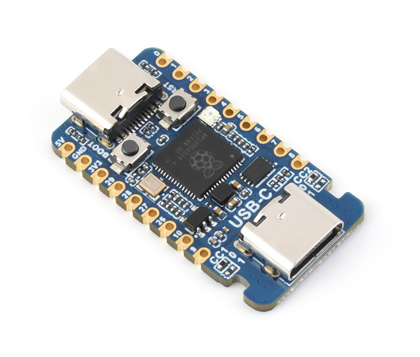
RP2350-USB-C
with PIO-USB female port
C/C++, MicroPython, Arduino support
Comprehensive SDK, dev resources, tutorials to help you easily get started


Dual-Core, Dual-Architecture
The unique dual-core, dual-architecture capability of RP2350A allows users to choose between a pair of industry-standard ARM Cortex-M33 cores, and a pair of open-hardware Hazard3 cores, giving developers a chance to experiment with the RISC-V architecture in a stable, well-supported environment

15 × multi-function GPIO pins
Configurable pin function, allows flexible development and integration

Board specifications
- RP2350A microcontroller chip designed by Raspberry Pi in the United Kingdom
- Adopts unique dual-core and dual-architecture design: dual ARM Cortex-M33 or dual Hazard3 RISC-V processors support, flexible clock running up to 150 MHz
- Built-in 520KB Static RAM, with onboard 2MB Flash
- Type-C port for easier use
- Supports power supply via Type-C port (PD compatible)
- Castellated module allows soldering directly to carrier boards
- USB 1.1 with device and host support
- Low-power sleep and dormant modes
- Drag-and-drop programming using mass storage over USB
- Adapting 15 × multi-function GPIO pins from the RP2350A
- 2 × SPI, 2 × I2C, 2 × UART, 4 × 12-bit ADC, and 14 × controllable PWM channels
- Accurate clock and timer on-chip
- Built-in temperature sensor for real-time monitoring of chip temperature
- 12 × Programmable I/O (PIO) state machines for custom peripheral support
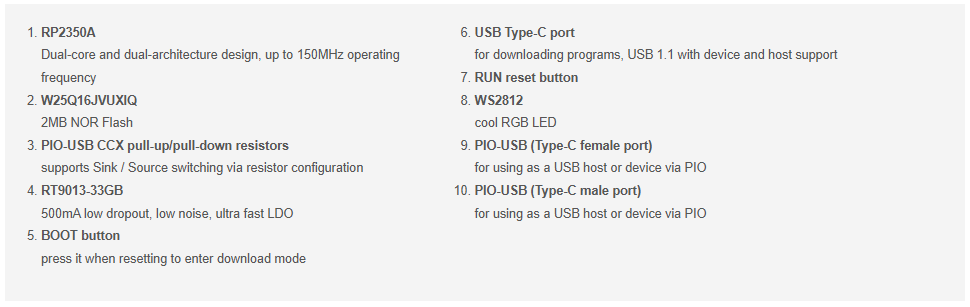
What's On Board

Outline Dimensions
RP2350-USB-C with PIO-USB female port

Wiki: RP2350-USB-C