For students, turning an engineering idea into a working prototype is an important part of learning. But moving from a schematic or CAD model to a manufactured product can be challenging when budget and access to manufacturing resources are limited.
The PCBWay Future Innovators Program is designed to help students and educational institutions bridge that gap. By providing manufacturing support for eligible educational and non-commercial projects, PCBWay helps students gain hands-on experience and turn their ideas into real, testable hardware.
Engineering education goes beyond textbooks and simulations. Designing a circuit, creating a PCB, building a mechanical enclosure, and testing a working prototype allow students to understand how engineering concepts translate into real-world products.
For many student projects, however, manufacturing can become a practical challenge. Prototype costs, limited access to equipment, and the difficulty of producing small quantities may prevent students from taking a project beyond the design stage.
This is where manufacturing support can make a difference.
With the Future Innovators Program, eligible students can receive support for projects related to education, research, competitions, graduation projects, open-source development, and social-impact innovation.
The program is intended to support more than just PCB fabrication. Eligible manufacturing charges can include:
This gives students more flexibility when developing complete prototypes that combine electronics, mechanical parts, and enclosures.
For example, a robotics team may need a custom PCB, CNC-machined structural parts, and 3D-printed components. A student developing an IoT device may need both PCB assembly and a custom enclosure. By bringing these manufacturing capabilities together, PCBWay can help students move more efficiently from concept to physical prototype.
The Future Innovators Program provides two support options based on who is purchasing and how the products will be used.
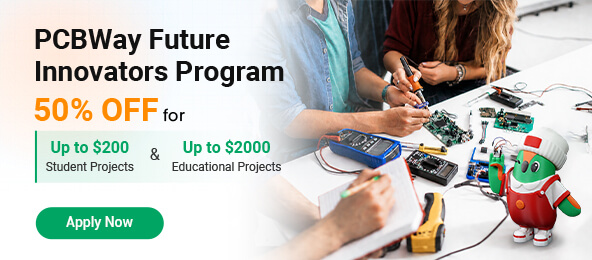
Verified students working on educational, research, competition, graduation, or non-commercial maker projects can receive 50% off eligible manufacturing charges, up to USD 200 per approved project.
The support is project-specific and intended for genuine student participation. Commercial production, resale, and customer-delivery orders are not eligible.
Schools, departments, laboratories, and educational programs can apply for expanded support when purchasing products for classroom teaching, laboratory training, workshops, or student projects.
Eligible school purchases can receive 50% off eligible manufacturing charges, up to USD 2,000 per approved purchase.
This option can be particularly useful for educators who need multiple PCBs or prototype parts for laboratory exercises, teaching kits, workshops, or student training.
The program is designed around practical learning and innovation. Eligible projects can include:
The goal is not simply to reduce manufacturing costs, but to make it easier for students to learn by building.
A student project often develops through several stages: defining a problem, designing the solution, creating hardware, manufacturing prototypes, testing the result, and improving the design.
Manufacturing is an important part of this process.
A fabricated PCB can reveal layout or assembly issues that are difficult to identify from a schematic alone. A 3D-printed enclosure can expose mechanical interference. A CNC-machined part can help students evaluate fit, strength, and usability.
These iterations turn manufacturing into part of the learning experience rather than simply the final step of a project.
Applying for the program is designed to be straightforward:
01 — Create a Quote
Prepare the relevant PCBWay quotation or order for your project.
02 — Submit Your Application
Provide your student or institutional information, project details, and quote or order number.
03 — Eligibility Review
PCBWay reviews student status or institutional eligibility, project purpose, feasibility, branding requirements, and other program conditions.
04 — Receive the Result
Approved support is linked to the verified account and designated project.
05 — Pay & Produce
After approval, pay the adjusted amount and continue with the normal manufacturing process.
Approved support should normally be used within 30 days, and changes to the materials or order may require another review.
Innovation often starts with a simple idea: a circuit a student wants to build, a robot they want to improve, or a problem they believe they can solve.
At PCBWay, we believe students should have the opportunity to take those ideas beyond the screen and into the real world.
Through the PCBWay Future Innovators Program, we aim to lower some of the manufacturing barriers faced by students and educational institutions while encouraging hands-on engineering, experimentation, and innovation.
Whether it is a graduation project, research prototype, competition entry, classroom project, or social-impact idea, the next great project can start with a student willing to build it.
Have a student project ready to build? Explore the PCBWay Future Innovators Program and see if your project qualifies for support.